Women in private security in South Africa: the roles, the numbers, the barriers and what is changing
A growing share of the register, from estate gates to control rooms to close protection, and a long way still to go on the roles women are steered into.
TenEight Team · 15 September 2026
Women in private security are no longer the exception on the roster. They are a growing share of the active register, they hold posts from estate gates to control rooms to close protection, and employers who once treated a female officer as a special case now advertise for them because clients ask. The industry still has a long way to go on pay parity, on facilities, on safety and on the roles women are steered into.

Where women in private security work
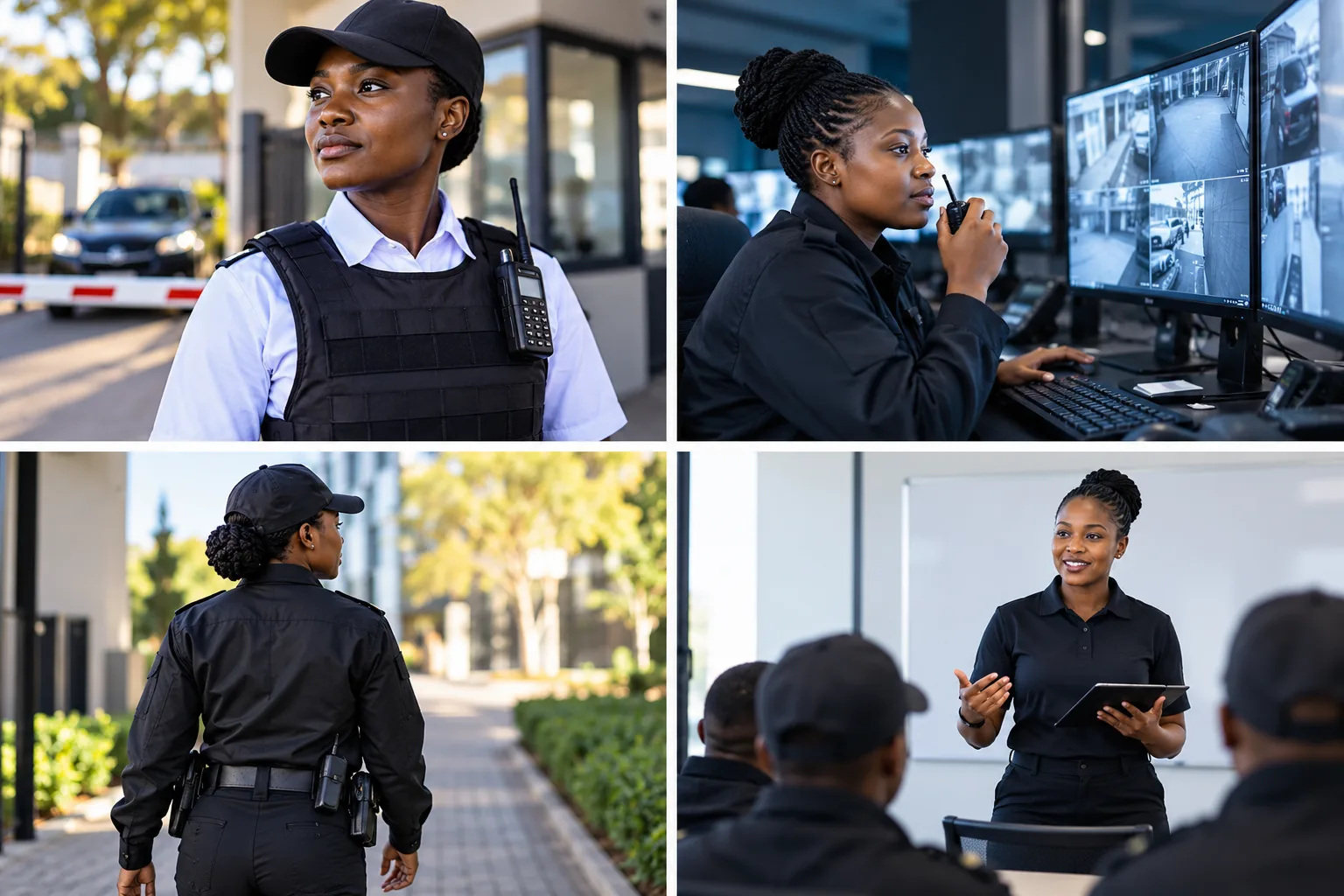
The stereotype has women at the retail entrance and men on the perimeter. The picture is wider than that:
Access control and reception security: the largest concentration, at estates, offices, hospitals, shopping centres and events, where searching female visitors, handling the public and running the visitor system are core to the post.
Control rooms: a fast-growing share of operators and controllers, where the work rewards judgement, communication and calm rather than physical size. Our control room operator guide covers the role.
Supervision and site management: Grade B and A women running sites and contracts, particularly in retail, healthcare and corporate security.
Event security: women are required by law and by clients for searching female patrons, and event companies recruit them continuously.
Close protection: a small but established group of female CPOs, in demand for protecting women and children and for assignments where a female officer blends in where a man cannot.
Armed response and CIT: still heavily male, but no longer closed. Women with firearm competency work both.
The numbers
PSIRA does not publish a definitive gender breakdown in every report, but the trend across its annual reports and industry surveys is consistent: women are a minority of active officers, in the region of a fifth to a quarter, and their share has risen year on year for more than a decade. In access control and control rooms the share is far higher. In armed roles far lower. The growth is real. The parity is not there yet.

The barriers that remain
Steering. Women are routinely placed on reception and retail posts regardless of their grade or ambition, and not offered the firearm competency, control room or supervisory training that leads to higher pay. The grade ladder and the specialist courses are the same for everyone. The offers are not.
Facilities and safety on post. Single-officer night posts without a secure guard house, no separate ablutions, no transport at 06:00. Problems for every officer, and sharper for women. Employers who fix them keep female officers. Those who do not lose them in the first month.
Harassment. From clients, the public and colleagues. The code of conduct and the labour law both apply, and companies with a working grievance procedure and supervisors who act on it are the ones women stay with.
Pay. The Sectoral Determination 6 minimum is the same for every officer of a grade and area (the law does not distinguish), but above the minimum, the higher-paid roles are the ones women are less often offered. Parity in law, not yet in practice.
Assumptions at the interview. "Can you handle a confrontation?" is asked of women and not of men. The right answer is a procedure, not a promise of force, and it is the same answer the industry should want from everyone.
What has changed
Clients now ask for women on posts where searching, dealing with families or handling sensitive situations is part of the work, and many tenders specify a minimum share. Control rooms have opened a large, well-paid, indoor career path. Training providers report rising female enrolment at Grade E and D. And the visible examples (women running sites, controlling shifts, protecting principals) have made the ambition ordinary where it used to be remarkable.
For women entering or moving up in the industry
Get to Grade C early. It opens control rooms, supervision and the specialist courses. Our PSIRA grades guide explains the ladder.
Ask for the course, in writing. If your company sends men on the control room course and not you, ask why, and ask again.
Consider the control room if a career off the gate appeals. It is where the industry's growth and its supervisors are.
Record every certificate on your profile. Employers on TenEight advertise by grade and requirements, so you can browse security jobs that match what you hold and apply through a free profile that puts your qualifications, not assumptions, in front of them.
Know the grievance procedure and use it. A company that punishes a grievance is a company to leave.
For employers
Post by grade and requirement, not by gender, and offer training on the same basis to everyone at the grade.
Fix the post before you fill it: secure guard house, ablutions, lighting, transport at shift change.
Run a grievance procedure that works, with supervisors trained to act on it, and act on it visibly.
State the roster honestly in the advert. Women with children are not the only officers who need to plan, but they are the ones most often lost to a roster that changes without notice.
Track your numbers: by role and by grade, not just in total. A workforce that is a quarter women and has none above Grade C is telling you where the problem is.
Quick answers
Can women work in private security in South Africa?
Yes, in every role (access control, control rooms, supervision, events, close protection, armed response and cash-in-transit) with the same PSIRA grades and courses as men.
What percentage of security guards in South Africa are women?
In the region of a fifth to a quarter of active officers, rising year on year, with much higher shares in access control and control rooms and lower shares in armed roles.
Do female security guards earn the same as male security guards?
The legal minimum is the same for every officer of a grade and area. Above the minimum, women are less often offered the higher-paid roles, which is where the gap in practice comes from.
Sources
PSIRA annual reports and Sectoral Determination 6 via the Department of Employment and Labour. Gender figures are approximate and drawn from published reports and industry surveys. Check the latest PSIRA report for current numbers.